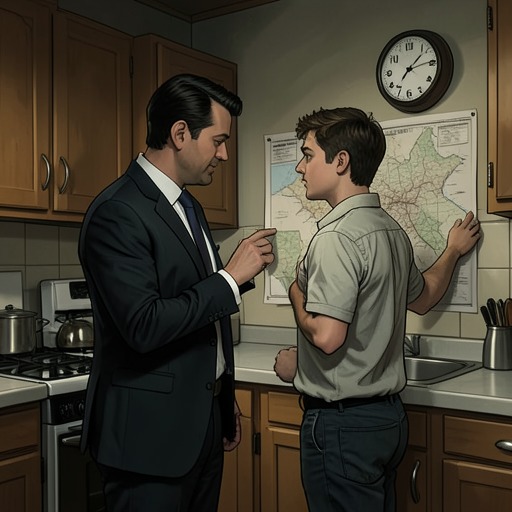
Scott tries to catch up with his moving family
The Shrinking ManThe family’s move turns a brief chance of escape into a failed pursuit: Scott sees Marty and Beth Carey clearing the cellar, realizes they are leaving, and tries to catch a ride on Marty’s trousers. The episode makes departure both a practical opportunity and a measure of Scott’s isolation. At his scale, an ordinary packing job is a sequence of enormous, dangerous movements; even when he reaches the stairs, he cannot make the family recognize that he is still there.
The move becomes visible
The scene begins with Scott watching a giant clear the cellar. The man reaches across the red metal table, throws down large cartons, and pulls out a blue suitcase that Scott recognizes as Louise Carey’s. A glen-plaid suit identifies the figure as Marty, not the giant Scott had seen on Wednesday. What first appears to Scott as an alarming disturbance becomes legible as packing: cartons, canvas chairs, and a net pole are moved, and Marty takes another suitcase. Scott understands the implication only when the objects assemble into a pattern. The family is moving.
That recognition changes the meaning of the cellar’s activity. The cartons and furniture are not simply hazards crossing Scott’s landscape; they are the visible signs that the people who share his home are about to leave it. Beth Carey bends to take a suitcase, while Scott runs toward Marty and calls out to him. His urgent appeals do not interrupt the work. The contrast is stark: to the family, the cellar is a space being emptied; to Scott, it is the last place from which he might reach them.
A plan built around Marty’s return
Scott initially judges the climb to the cellar’s upper level impossible at his current size. Hope returns when he remembers that Marty has said he will come back down. Rather than attempt to climb a shoe without a secure hold, Scott forms a more deliberate plan: seize Marty’s trouser leg, perhaps get inside the cuff, and hold on until Marty carries him into the house. Once there, Scott imagines reaching a table or chair and waving cloth so Louise Carey will know he is alive. The plan is not simply escape from the cellar; it is an attempt to make himself visible to his family again.
He recognizes that the opportunity may be brief. Marty would pass the step too quickly for Scott to act if he waited for him to return, so Scott decides he cannot wait. He races toward the red metal table as Marty lifts a carton and heads for the stairs. The difference between planning and execution is compressed into that narrowing interval: Scott has identified a route, but must take it while the person carrying it is already moving.
The attempted attachment fails
As Marty’s black shoe comes down in front of him, Scott flings his hook toward the swaying trouser leg. The attachment catches, but not in a way Scott can control. Marty’s movement pulls Scott through the cellar, swinging him violently and carrying him toward the steps. He reaches the first step, but the impact tears him free. Scott then moves across the cement toward the second step, loses his footing, and is left on the floor as Louise Carey’s shoe comes down close by before moving away.
The result reverses the promise of Scott’s plan. Marty’s movement does carry him toward the stairs, but the ride is uncontrolled, and reaching the steps does not become a safe ascent. Scott’s attempt ends before he can enter the house or signal to Louise. The danger comes not from deliberate opposition but from the mismatch between his small body and the scale and speed of ordinary actions around him. A trouser leg can serve as a ladder only if Scott can hold on; a step can be a route upward and, at the same time, an obstacle he cannot negotiate.
What remains after the family leaves
Later, while Marty is driving the family to the railroad station, Beth notices the hook and thread attached to his trouser leg and removes them. Marty assumes he picked them up in the cellar. Beth puts them in her overcoat pocket, and then forgets them too. The objects that carried Scott’s attempt into the family’s immediate space therefore fail to carry its meaning. The family takes the hook and thread away, but neither recognizes them as evidence that Scott tried to follow.
This aftermath sharpens the episode’s separation. Scott’s effort is physically close to success: his improvised line reaches Marty, and his presence comes within a short distance of Louise. Yet proximity does not produce recognition. For Scott, the moving family offers a possible passage from the cellar back into shared life; for Marty and Beth, the attached thread is only something picked up among the household’s possessions. The move continues, while Scott remains behind, and the difference between being near his family and being known by them becomes the event’s decisive consequence.